📕 4. The Discipline Narrative
Are You Where You Should Be?
This is Module 4: The Discipline Narrative, which should be completed between 2/15 - 2/21. If you haven’t completed everything in Module 3, go back and finish all outstanding tasks now. Don’t forget to click on and review each resource in this guide.
Goals and Checklist
- Learn more about developing research questions
- Develop 3 potential research questions from preliminary research conducted in Module 2
- Learn about discipline narratives
- Draft a discipline narrative of your own
To help with various access needs, including task identification and separation and advance notice, I’ll include an abbreviated list of tasks at the top of each weekly module. You can check these items off, but your input won’t be saved after you close this window. You remain responsible for checking the Calendar and ensuring that you’re completing everything in a timely fashion.
Mythbusters: The Academic Edition
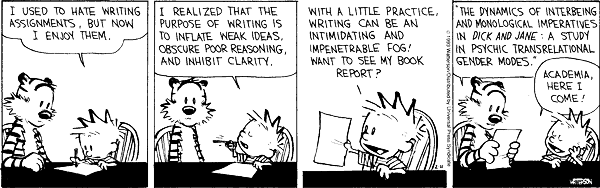
Image: Calvin & Hobbes comic strip making fun of academic writing as impenetrable and obscure.
This comic illustrates the stereotype of academic writing: that if it doesn’t “inflate weak ideas, obscure poor reasoning, and inhibit clarity,” it’s not good writing.
Since you’re about to start drafting the first part of your qualitative research project, it’s a good time to debunk some of these stereotypes and figure out ways to sustain yourself through a long-term writing project.
Myth: Writing in the disciplines is something that only happens in core writing courses.
Reality: You’re not just in college to earn degrees, just like you’re not just in classes to learn about subject matter — you’re always also learning about an academic discipline and acquiring disciplinary knowledge. An academic discipline is a field of knowledge in systems of knowledge production with distinct problems, assumptions, methodologies, and communicative expectations. (For instance, scientists, historians, and performing artists are all trained to perceive and explain phenomena very differently!)
Myth: Good writers know exactly what they want to say before they start writing.
Reality: Good writers learn by writing — which is how we think and process our thoughts! — and remain adaptable and open to having their minds changed.
Myth: Readers, especially academic audiences, are seeking black and white explanations.
Reality: All readers want to read work that unpacks the complexity of an issue — and they trust writers who aren’t afraid of trying to explain and account for all the complexities of an issue!
Myth: Your research hypothesis should be one-sentence long.
Reality: Your research hypothesis should require ~5 sentences minimum, since research hypotheses consist of several steps or concepts that take multiple sentences to explain.
Myth: I can do most of this work the night before the deadline.
Reality: In Write No Matter What, Joli Jensen recommends “frequent, low-stress contact with a project that interests me, in a supportive environment” to sustain academic writing. The best approach is to work on something for your qualitative research project a little every day. The scaffolded, often collaborative nature of the work we do in this class means that you’ll probably struggle if you delay working on assignments until close to the deadline.
Developing Research Questions
Qualitative research questions can be posed without citing existing literature, but they always grow out of existing literature.
Research questions (RQs) do one or more of the following:
- Contextual RQs: Identify and describe a phenomenon
- Descriptive RQs: Describe a phenomenon
- Explanatory RQs: Examine a phenomenon or analyze the reasons or relationships between phenomena
- Exploratory RQs: Consider unknown dimensions of a phenomenon
- Ethnographic RQs: Build on existing literature
- Case Study RQs: Describe and explore a particular case study
Drafts often begin with research questions, but once you’ve read enough to tentatively answer them, you’ll replace the RQs with research hypotheses. problem statements, or the hypothesis you’ve arrived at by trying to answer that question, signaling to the reader that the paper will explain how you arrived at that hypothesis.
Here are some examples that demonstrate different kinds of research questions. Try to identify each kind of RQ below, then check yourself by clicking each item to reveal the answer.
▶ What are the experiences of nurses working night shifts in healthcare during the COVID-19 pandemic?
Explanatory, both examining a phenomenon and analyzing the relationships between two phenomena (night shift nursing, COVID-19)▶ How have contemporary public perceptions of genetic engineering impacted scientific funding for genetic research?
Descriptive, describing a phenomenon; and ethnographic, likely to build on research into public perceptions of genetic engineering▶ What are the forms of disrespect and abuse experienced by women criminal justice attorneys, and how does this impact substance abuse in the profession?
Contextual, identifying and describing a phenomenon; and exploratory, considering unknown dimensions (misogyny) of a known problem (substance abuse)▶ How have changes in research protocols around human subjects improved (or not) human subject research in anthropological research?
Exploratory, considering unknown dimensions of a problem (changes in research protocols); case study, likely to examine 1-2 case studies; ethnographic, likely to build on existing case studies to examine their research protocolsQualitative research questions are frequently revisited, reviewed, and revised. The tentative answers you pose to your research questions, i.e. your research hypotheses, are always preceded by a statement describing a phenomenon, after which they broadly explore a complex set of factors surrounding that phenomenon.
Practicing Disciplinary Thinking
Membership in a disciplinary community requires learning to “talk the talk” — becoming literate in the discipline’s ways of thinking and writing, language, genres, and practices, knowing what to say to people inside a disciplinary community and those outside of it.
Disciplinary Scholarship = by Disciplinary Members
It’s fine if you find yourself reading scholarly articles for your preliminary research that aren’t produced in your disciplinary community; just remember that the disciplinary conventions you should pay attention to must come from scholarship produced by members of your field.
Professions emerge from disciplines taught in college, and disciplines are informed by professions and their evolution outside of college. Developing your research questions and writing a discipline narrative are opportunities to continue reflecting on what you consider your discipline, how it connects to the work you’re doing in your major, and where and how you’re being trained in disciplinary thinking. It can help you think about crafting a research paper to ask yourself: What models have you been given so far? What phrases, terms, abbreviations, etc. do you encounter in your major courses? (For instance, an education major might ask themselves: “What am I learning about being a teacher? About thinking like a teacher? About the language of teaching and education?”)
Extrapolating research questions from preliminary research can also help you figure out where to look specifically to develop these disciplinary literacies, by exposing you to the kinds of writing done in your field and the language that gets deployed in the discourses surrounding a specific problem, tension, challenge, or issue faced by your discipline.
The texts produced by members of your discipline is where you can see disciplinary literacies and the thought processes behind them in action. Remember, writing is thinking, so disciplinary writing is disciplinary thinking! For example (if you need a reminder), the hard sciences’ reliance on third-person perspective and passive voice conveys a sense of clinical distance and objectivity that is a crucial part of scientific work and identity. Social science research, especially ethnographies, are much more likely to use first-person and subjective, vivid description, illustrating their need to contrast the researcher’s perspective with the group or phenomenon being observed.
What Is a Discipline Narrative?
The discipline narrative is one such place to practice disciplinary thinking and writing in your qualitative research project. Your discipline narrative is a more elaborate summary of the phenomenon (plus any relevant surrounding factors) described in your research questions. For the purpose of the qualitative research project, the discipline narrative will span the 2 paragraphs that precede the 1 paragraph of research hypotheses in your Research Introduction.
🛑 Stop: Watch!
Watch the below video, “ENG 201 Discipline Narrative,” produced by Pace Library, which contains tips on conducting effective database searches.
In the video above, Jessica Kiebler from Pace’s Library explains the ENG 201 Discipline Narrative, as well as how to pose research questions and transform them into problem statements.
This might also be a good time to skim Model Paper 1 and Model Paper 2 produced by Pace students who have taken this class before. These papers are also posted to Classes\Content\Model Papers. You don’t need to read these papers in their entirety yet, but reading their “Research Introductions” might help you reason through how to write your own.
Writing Tip!
When it comes to writing, nothing is static. What once worked for your writing process once may not work in the future. Your changing circumstances may change how you write. When that happens, clinging to what worked before will just hold you back. (For instance, hyperfocus might work for a while, then give way to scheduled “discovery” free-writes, where you write to see where your thinking takes you; or no outlining might yield to index cards and research.)
It might also help to skim Yale’s repository of model student papers across the disciplines, a resource referenced later in this OER as well.
🛑 Stop: Develop RQs
Based on your preliminary research, what have scholars writing about the discipline already said about these issues? From the work you’ve done, write a paragraph that answers the questions below to help you develop your research questions:
- Identifies and describes the discipline you’re studying (1 sentence)
- Identifies and describes some of the issues taking place in the conversations in your discipline (2 sentences)
- What provisional research questions, i.e. RQs in the developmental stages based on preliminary research, do you have at present? Phrase them like this: “How does [the issue] affect workers in your discipline? Why does it appear and affect them like that? According to the literature, how do workers seem to cope with it?”
🛑 Stop: Post Your RQs in #team!
Post the paragraph you drafted, especially the RQs, to your #team channel! I’ll offer quick comments, and in doing so, model for you and your teammates how to think about constructively critiquing and revising your RQs.
Some additional advice: Remember that if you say you’re going to do something, your audience will expect you to thoroughly, believably do it. It’s best to avoid questions that attempt to answer huge problems, i.e. “How can we improve X,” “What would stop X,” because you need a lot of space to thoroughly explore such questions.
Avoid questions with yes/no answers! Use exploratory how/why questions that are linked to the phenomenon you’re investigating, and try to tie your questions to the situations you describe. Try not to focus on figuring out super subjective things like trying to solve the problem.
Finally, a research paper isn’t a mystery story: ultimately, your goal is to tell the reader about the journey they can expect in your paper and deliver some version of that (not the same as restating your claim as your conclusion). And as for specificity, aim to be so specific you start to wonder if you can even write a paper about it/find anything on it — it might feel scary, but chances are good that’s where it’s finally specific enough!
Exit Writing
🥳 Congratulations on getting through this chapter! Don’t forget to check the Calendar for the week’s assignments, including your Tue question and Fri answer posts, posting as well as any other assigned writing. Make sure to look ahead to future weeks as well to get a sense of when low- and high-stakes writing for Unit 1 is due.
Reference List for This Week’s Resources
| ENG 201 | Model Paper 1 |
| ENG 201 | Model Paper 2 |
| Pace Library | ENG 201 Discipline Narrative |
| Yale University | Repository of Model Papers |