🔄️ 13. Qualitative Coding
Are You Where You Should Be?
This is Module 13: Qualitative Coding, which should be completed between 4/19 - 4/25. If you haven’t completed everything in Module 12, go back and finish all outstanding tasks now. Don’t forget to click on and review each resource in this guide.
Goals and Checklist
- Review what makes an effective argument
- Learn about argumentative synthesis
- Practice strategies for argumentative synthesis
To help with various access needs, including task identification and separation and advance notice, I’ll include an abbreviated list of tasks at the top of each weekly module. You can check these items off, but your input won’t be saved after you close this window. You remain responsible for checking the Calendar and ensuring that you’re completing everything in a timely fashion.
🛑 Stop: Reread!
Reread Johnny Saldana’s “An Introduction to Codes and Coding”, paying special attention to the examples he provides.
When you finish conducting and transcribing your interviews, you’ll organize this textual data using qualitative coding.
What Is Qualitative Coding?
Qualitative coding is a fancy name for pattern recognition. In Saldana’s words, “In qualitative data analysis, a code is a researcher-generated interpretation that symbolizes or ‘translates’ data, and thus attributes meaning to each individual datum for later purposes of pattern detection, categorization, theme, assertion or proposition development, theory building, and other analytic processes.” Coding involves highlighting recurring words, phrases, or themes and identifying their frequency and significance. The goal is to capture meaningful patterns in textual data. It has been described as the bridge between data collection and how they explain meaning.
As Saldana says, the same way that a title represents the essence of a book or movie, a code is meant to capture a unit of data’s essence; in these interview transcripts, these units of data are the phrases, sentences, and other bits of text that make up your interviewees’ responses. A well-developed code — one that is specific and emerges from the respondents’ words and connotated affects and emotions — can stand on its own and represent an aspect of the transcript as a whole.
Information is coded for the following reasons:
- Codes in qualitative research are as important as numbers in a quantitative study;
- Coding the qualitative data makes the messy scripts quantifiable and provides structure;
- Your codes give you credibility as a writer with your audience;
- Proper coding allows you to say with confidence that your findings truly represent the data you reviewed.
Coding is not looking over your interviews or media content once. The process is far more complex and requires several “passes” or steps taken to develop categories or themes.
- Pass 1: In this step, you will review each interview line-by-line. While doing so, you will write summary statements in the margin of your paper — what you are noticing as you are reading, ideas and statements that directly relate to your research question. For example, you may notice a feeling of anger in the text (not from you). You should make a note of this. To do so, highlight the passage in your Word doc and select “comment.” Next, write in your thoughts.
- Pass 2: Once you are done with the first pass, you will now want to consider how your codes (for example anger) work together. This is known as developing categories or themes.
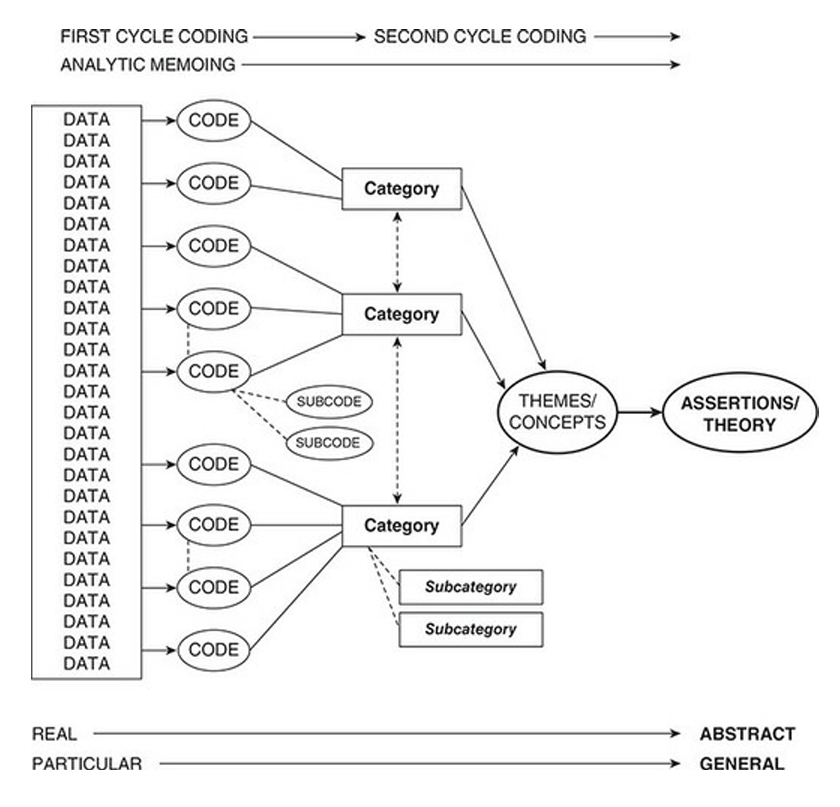
Qualitative coding is a multi-part process. First cycle coding is used when you’re just getting started with coding. Second cycle coding is used when you’re refining your codes into categories that are more attuned to your research hypotheses as well as the data.
First Cycle Codes
First cycle coding is about initial analysis, a kind of deconstruction of wording and connotation to see how an interviewee’s responses work. Second cycle coding is refinement and synthesis, getting more specific with the codes themselves and reconstructing an assemblage of meaning.
When you’re engaged in first cycle coding, you can code data ranging from a single word to a full paragraph, or an entire page of text. (Keep in mind, though, that the more parts you code, the easier it will be to analyze your interview transcripts and write your Unit 3 drafts!)
Some coding methods within first cycle codes that work well for this project include: descriptive coding, in vivo coding, and process coding.
🛑 Stop: Read!
Read Johnny Saldana’s In Vivo Coding, Descriptive Coding, and Process Coding. Pay special attention to the example transcripts at the end of each section!
Second Cycle Codes
Second cycle coding methods reorganize and reanalyze data coded through first cycle methods. They ask you to link seemingly unrelated items logically, align categories together, and develop a coherent synthesis of interview data.
The goal of second cycle coding is to develop a sense of categorical, thematic, conceptual, and/or theoretical organization from your first cycle codes. In second cycle coding processes, the data you code can be the same length, shorter, longer, or even consist of a reconfiguration of the codes you’ve developed so far. This second iteration of coding is meant to help you categorize the initial codes and move you closer to data analysis.
Basically, your first cycle codes will be reorganized and reconfigured into a shorter and more select list of broader (but specifically named!) categories, themes, concepts, assertions, and/or propositions. So if you generated 50 different codes for your interview transcripts in your first cycle coding, you would recode those 50 codes in your second cycle coding and might end up with 25 codes in one category, 15 in a second category, and 10 in a third.
Before you assemble categories, you may need to recode your data if you discover more accurate words or phrases than the original codes. Some codes may end up combined because they’re conceptually similar. Infrequently occurring codes might be deleted because they’re not very useful in the overal coding scheme. Some codes that seemed like good ideas during first cycle coding may be deleted because, after reviewing everything, they aren’t needed, after all.
Some coding methods within first cycle codes that work well for this project include: focused coding, pattern coding, axial coding, and theoretical coding.
🛑 Stop: Read!
Read Johnny Saldana’s Focused Coding, Pattern Coding, Axial Coding, and Theoretical Coding.
Coding Your Interviews
Preparing to Code
By now you should have conducted at least one of your interviews, recorded it, and transcribed it (created a word-for-word transcript). Once you have interviewed your participants and transcribed your interviews, you can begin coding them! Aim to have most of the text coded, i.e., few words should be unmarked by the end of your coding cycle. Try the following brainstorming activity before you start coding:
- What words keep reappearing across the interview answers from all the participants? (Use color coding or the comment function to mark them.) Use them to name some codes!
- What is the significance of these codes and how frequently they appear?
- What themes keep reappearing across the interview answers from all the participants? How might you briefly describe them? (Use color coding or the comment function to mark them.) Use them to name some codes!
- What is the significance of these codes and how frequently they appear?
First Cycle Coding
🛑 Stop: Try Doing First Cycle Coding!
Follow the directions below to try doing first-cycle coding on your interview transcripts!
Now, choose one of these first cycle code processes to use to code your interview transcripts. It’s helpful to print your transcripts, as coding by hand is often easier to do on a hard copy.
Circle key words and phrases in pencil (in case you need to erase and modify later). Starting with In Vivo Coding is a good idea, as it keeps you grounded in the interviewee’s voice and might feel more authentic and instinctive than other methods. Keep yourself open to other options, as you might need to choose a different method later. Try to be detail-oriented and look for nuance. (Saldana, 2021).
As you engage in this activity, don’t forget: coding is in service to thinking; it’s like creating a map of your thinking for others to follow!
Second Cycle Coding
🛑 Stop: Try Doing Second Cycle Coding!
Follow the directions below to try doing second cycle coding on your interview transcripts!
As a post first cycle coding process, try doing some of the following activities suggested by Saldana (2021) to make sense of your coding results and figure out what patterns are most important, how to refine the names of your codes, and thus how to transition into second cycle coding:
- Counting code frequencies
- Alphabetizing the codes to search for patterns
- Categorizing codes or themes
- Outlining the codes or themes in categorical or hierarchical order
- Transforming codes and categories into concepts, or themes into theoretical constructs
- Creating found poetry with In Vivo Codes
- Adapting data into dramatic monologues or narrative vignettes
- Recoding data with a different coding method
Instructions for Coded Interview Transcripts
🛑 Stop: Try Doing First Cycle Coding!
The following instructions are in regards to the coded interview transcripts you’ll submit to your #teams channel by Saturday. These transcripts should include the entire annotated interview transcript, i.e. all your questions and all interviewee responses.
- Copy all of the transcripts you coded in the exercises detailed above into one file and label each one with the interviewee’s name, the date of the interview, the platform (F2F, video conferencing technology, email), and length (time).
- List your first cycle codes and second cycle codes at the top of the document.
- Create a color scheme for your second cycle codes and color-code each line to which a second cycle code applies. (You may use the comments function instead of color coding if that’s easier.)
Your coded transcripts might look like:
[Name of First Cycle Code 1] Educational Classroom Issues
[Name of First Cycle Code 2] Emotional Labor and Mental Health
[List of Names of Second Cycle Codes and Color Coding] Green: Teaching from a lesson plan Yellow: Managing behavior Red: Frustration with administration Purple: Anxiety about workload Blue: Supporting students through trauma
INTERVIEW 1 Interviewee: [Color-coded Dialogue etc.] You: [Question or probe question] Interviewee: [Color-coded Dialogue etc.] Etc.
Try to code every line — they may be similarly or differently themed — and post your prewriting as a reply to this thread!
Tip!
If it helps to see examples, here’s a model coded interview transcript by a former student.
Exit Writing
🥳 Congratulations on getting through this chapter! Don’t forget to check the Calendar for the week’s assignments, including your Tue question and Fri answer posts as well as any other assigned writing. Make sure to look ahead to future weeks as well to get a sense of when low- and high-stakes writing for Unit 3 is due.
Reference List for This Week’s Resources
| Johnny Saldana | “An Introduction to Codes and Coding” |
| Johnny Saldana | In Vivo Coding |
| Johnny Saldana | Descriptive Coding |
| Johnny Saldana | Process Coding. |
| Johnny Saldana | Focused Coding |
| Johnny Saldana | Pattern Coding |
| Johnny Saldana | Axial Coding |
| Johnny Saldana | Theoretical Coding |