🖇️ Appendix - WID Models
Are You Where You Should Be?
It can be intimidating to try to deconstruct and imitate published scholarship written by professionals in your field! Below are Appendices that contain discipline-specific material that you can reference for examples of your discipline’s stylistic preferences.
Appendix 1: Science and Mathematics Papers
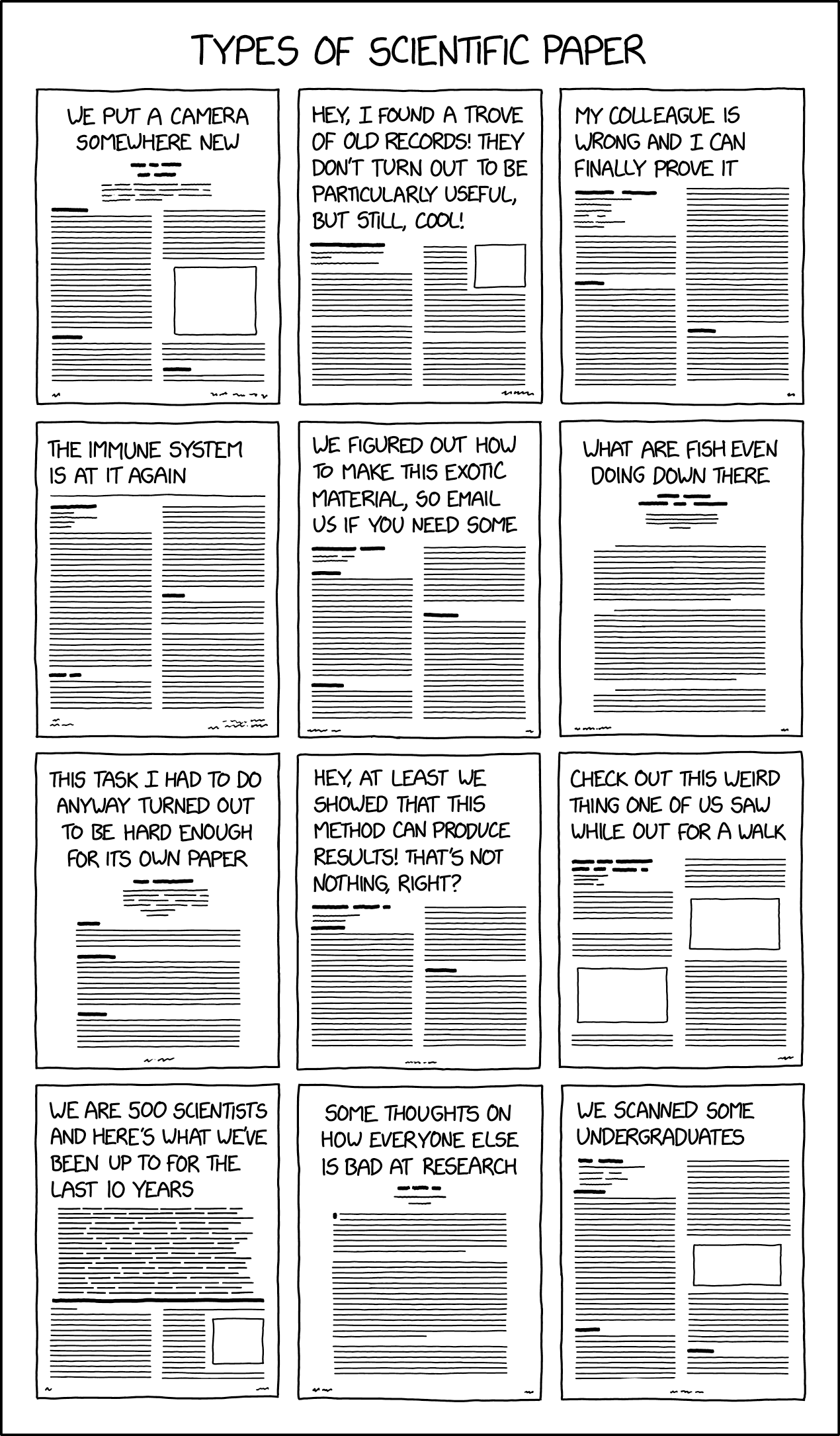
As the xkcd comic below indicates, you can loosely sort types of scientific research into the above categories. These subfields may possess additionally specialized discourse, but the genre conventions across the field remain more or less the same.
This chapter in the OER Writing the Disciplines focuses on the disciplinary conventions of science and mathematics papers.
Additionally, Chapter 22: Appendix B: A Guide to Research and Documentation includes a table that lists disciplines, distinctive features, and demands and strategies of disciplinary literacy. The details on Mathematics and Science disciplines are pictured below:
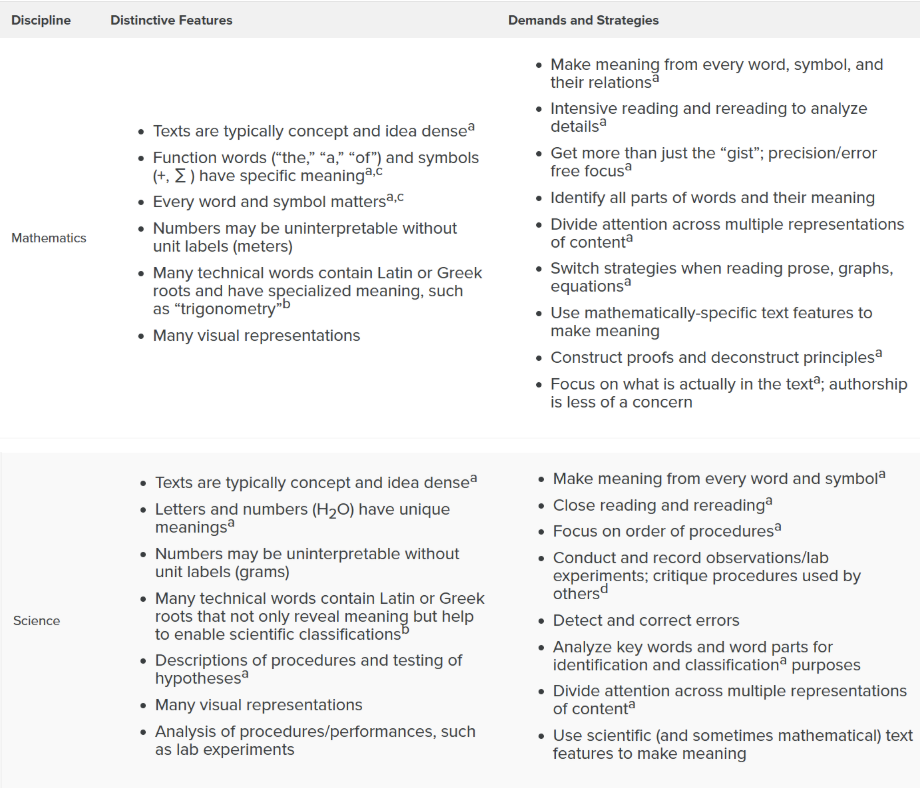
These conventions may apply to students majoring in areas like mathematics and mathematics-adjacent fields (like accounting, business, or economics, depending on the writing task), and the hard sciences (like chemistry, physics, material science, astronomy, and the biological sciences).
Finally, Yale University maintains a repository of model papers from across the disciplines, including the following subjects: anthropology; the biological sciences; classics; cultural criticism; English literature; environmental studies; film, first-year writing; visual, and performing arts; health and medicine; history; journalism; law; linguistics; music; narrative essays; philosophy; the physical sciences; political science; psychology; sociology; and women, gender, and sexuality studies.
Appendix 2: History (and Other Social Sciences) Papers
Chapter 22: Appendix B: A Guide to Research and Documentation includes a table that lists disciplines, distinctive features, and demands and strategies of disciplinary literacy. The details on History disciplines are pictured below:
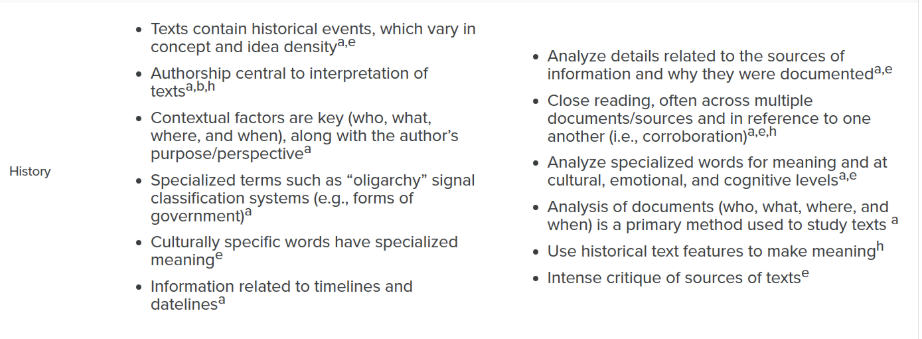
While these conventions are specific to history, they broadly apply to students majoring in social science areas, like anthropology, sociology, and cultural studies.
Many social science qualitative research papers follow the IMRaD format: Introduction, Methods, Results, and Discussion. The ENG 201 Qualitative Research Project uses a modified kind of ILMRaD (Introduction, Lit Review, Methods, Results, and Discussion) model — although the “L” and “M” sections may be flipped.
Appendix 3: English and Arts Papers
Chapter 22: Appendix B: A Guide to Research and Documentation includes a table that lists disciplines, distinctive features, and demands and strategies of disciplinary literacy. The details on English and Arts disciplines are pictured below:
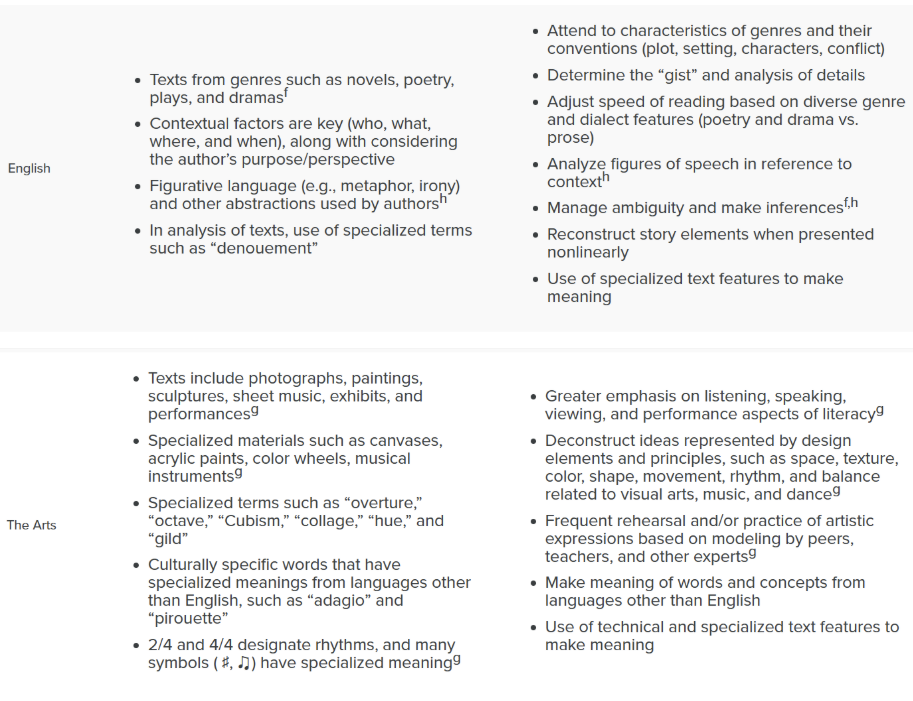
These conventions may apply to students majoring in other areas in the humanities as well.
Appendix 4: Criminal Justice and Law Writing Papers
This chapter in the OER Writing the Disciplines focuses on the disciplinary conventions of criminal justice and law writing.
WCU has also compiled a Criminology and Criminal Justice Research WID Guide aimed at exposing you to the various types of writing in these fields and helping you reflect on the disciplinary conventions they use.
Appendix 5: PR/News Release (Arts and Entertainment) Papers
This chapter in the OER Writing the Disciplines focuses on the disciplinary conventions of news writing and public relations writing.
Appendix 6: Practicing with Student Work
For a general overview on how to read and write using disciplinary conventions, check out the “Adapting to Disciplinary Literacy Conventions” in Open English @ SLCC.
It can be intimidating to try to deconstruct and imitate published scholarship written by professionals in your field. This list of winners of Yale University Writing Center’s essay contest includes model student papers across the disciplines that demonstrate, in a more student-accessible manner, the kinds of writing moves you might be expected to make in your majors right now at Pace.
Appendix 7: Model Student Work from ENG 201
Model student papers that received “A”-range grades in ENG 201 sections I previously taught.
Additionally, sample student final formatted semester-long projects from ENG 201 can be found here.
Reference List for the Appendix
| Chinni, Kielbasa, Shoup (2023) | Chapter 6: Scientific and Mathematics Research Paper Writing |
| English 201 OER | Understanding the ILMRaD Model |
| Lange and Radosh (2023) | “Writing a News Release: A Public Relations Staple” |
| LaTorre and Wells (2023) | “Writing a Criminal Report and Legal Brief” |
| Pace University | ENG 201 Final Formatted Semester-Long Project |
| Writing the Disciplines | Adapting to Disciplinary Literacy Conventions |
| The Writer’s Handbook | Chapter 22: Appendix B: A Guide to Research and Documentation |
| Yale Poorvu Center for Teaching and Learning | Model Papers from the Disciplines |