📚 9. Conceptual Saturation
Are You Where You Should Be?
This is Module 9: Conceptual Saturation, which should be completed between 3/22 - 3/28. If you haven’t completed everything in Module 8, go back and finish all outstanding tasks now. Don’t forget to click on and review each resource in this guide.
Goals and Checklist
- Create and fill out a conceptual synthesis dump (CSD) Excel spreadsheet
- Understand the purpose of creating an annotated bibliography
To help with various access needs, including task identification and separation and advance notice, I’ll include an abbreviated list of tasks at the top of each weekly module. You can check these items off, but your input won’t be saved after you close this window. You remain responsible for checking the Calendar and ensuring that you’re completing everything in a timely fashion.
Don’t Forget to Pay Attention to Weekly Feedback!
As we progress with Unit 2, this is a good time to revisit your weekly notes on my “lecture/feedback” responses each week.
🛑 Stop: Revisit!
Go back to my responses in #classroom (easily retrieved by searching for my username). Revisit my feedback during weekly Q&A in #classroom as well as the feedback from me and the Pace librarian in #ask-a-librarian-lit-rvw. Read my replies to everyone, not just to you.
Like an onsite F2F classroom, you’re responsible for taking notes on these class “lectures” and discussions. Remember, you’re responsible for using this information to help you construct your papers! If it gets said during the week, you’re expected to learn from, apply, and integrate it into how you write your work.
🛑 Write: Get Your RQs Near-Perfect
If you have been receiving No Credit (Nc) scores in Unit 1 and have not spoken with me about it, you may have a lot of extra work to do in Unit 2, as you must make sure your research questions are strong before beginning your literature review. If you start doing the literature review with weak questions, you’re likely to begin writing a report,
Evaluating Sources
While you’re allowed to use 3 popular publications and 3 scholarly articles for this assignment, it’s best to use 6 peer-reviewed scholarly articles. Whether you’re considering a peer-reviewed article or a popular publication, once you locate a source you think you might use, your first task is evaluating it to ensure it provides “good” information.
🛑 Stop: Review!
Review the Evaluating Information - Applying the CRAAP Test IF I APPLY page.
CRAAP and IF I APPLY are acronyms for criteria used to assess sources. Different criteria will be more or less important depending on your situation, exigence, and purpose in writing and researching.
CRAAP stands for:
- Currency
- Relevance
- Authority
- Accuracy
- Purpose
while IF I APPLY stands for:
- Identify emotions attached to topic
- Find unbiased reference sources for proper review of topic
- Intellectual courage to seek authoritative voices on topic that may be outside of thesis
- Authority established: Does the author have education and experience in that field?
- Purpose/Point-of-View: Does the author have an agenda beyond education or information?
- Publisher: Does the publisher have an agenda?
- List of Sources (Bibliography): Is the evidence sound?
- Year of Publication: Does the year of publication effect the information?
Inaccurate, outdated, or otherwise questionable sources can undermine your ideas and cause readers to question the credibility of the paper. Every time you locate a source you might use, you should use these criteria to figure out if it’s a relevant, informed source that can help you write a strong, convincing paper.
Articles in newspapers and popular magazines can help with preliminary research, where you’re figuring out the basics of your research hypotheses, but peer-reviewed periodicals are better for more advanced (and citable!) research.
Peer-reviewed scholarly articles are publications that have been evaluated and reviewed by independent experts in the field prior to publication. Here are some characteristics of peer-reviewed periodicals:
- The author is a scholar in the field
- The author cites their sources in footnotes or a bibliography
- The journal title contains the words Journal, Quarterly, or Review
- The journal is published or sponsored by a professional organization (such as the American Medical Association or American Bar Association)
- The journal is published by an academic or research institution
- There is little to no advertising
If you’re using a source accessed via the Internet (rather than through an electronic library database), you should consider the following:
- The website URL, which indicates what the agenda of the the sponsoring organization might be
- Any about page or mission statements that will reveal the sponsoring organization’s bias or stance
These things don’t necessarily disqualify or qualify a source but will help you determine if the website has any biases on either side of an issue or topic.
Aim for conceptual saturation, which Pacheco-Vega defines as “the point where I am seeing the same citations repeated on a regular basis. I borrow this term from qualitative research methods, as it is also the point when you are seeing the same concepts repeated over and over again.”
Reading and Annotating Sources
Last week, you learned about the anatomy of scholarly articles and how to find articles; this week, we’ll build on that by learning about strategies for reading, annotating, and identifying connections between the sources you find.
🛑 Stop: Read!
Read Ellen Carillo’s Working with Sources chapter and Pacheco-Vega’s How to Do a Literature Review: Citation Tracing, Concept Saturation and Results’ Mind-Mapping.
Thinking about research papers as source-based writing might help you reframe how you approach them: not as giant reports of facts and histories, but as engaging with ideas — not to prove anything, not to pick a side and defend it, but to explore, interpret, draw conclusions based on the sources, and explain how you arrived at those conclusions to your readers.
In her chapter, Carillo walks you through consistencies and differences between source-based writing and academic essays, observing that “reading these sources mindfully by applying the most relevant reading strategies is an important element of writing strong source-based papers” (p. 49).
🛑 Stop: Read!
Read Dr. Raul Pacheco-Vega’s Synthesizing different bodies of work in your literature review: The Conceptual Synthesis Excel Dump (CSED) technique
Pacheco-Vega explains here how to use an Excel spreadsheet to make what he calls a conceptual synthesis dump (which is a good way to prevent yourself from hurriedly copy-pasting a link that may not work in the future!).
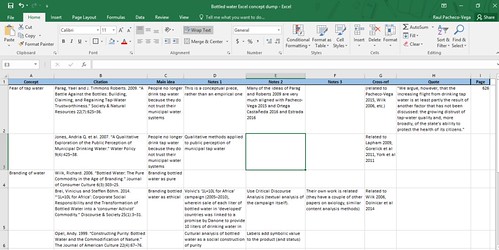
The above image is taken from Pacheco-Vega’s CSD file about one of his own WIP research projects. Using it as a model, create a CSD file for yourself, making sure to enter data into each of the columns. This will help you be careful and critical about the sources you select for your annotated bibliography.
🛑 Stop: Read!
Read this chapter on Annotating Sources!

This chapter offers several strategies for annotating sources (including Pacheco-Vega’s!).
A key tenet of doing research is: If you think you won’t forget it, you’re wrong — you will. Make careful notes. Don’t just paste a link into a document and call it a list of sources.
Write down what you think while reading, in the document or in a separate space like a notebook or a CSD file. The Research Methods Consortium offers this list of questions worth asking while you read, associating each set of questions with different parts of a scholarly article. The list below is taken from the chapter:
| Section of Paper | Questions Worth Asking |
| Abstract | What are the key findings? How were those findings reached? How does the author frame their study? |
| Acknowledgments | Who are this study’s major stakeholders? Who provided feedback? Who provided support in the form of funding or other resources? |
| Introduction/research hypotheses/problem statement | How does the author frame the research focus? What other possible ways of framing the problem exist? Why might the author have chosen this particular way of framing the problem? |
| Literature review | What are the major themes the author identifies in the literature? Are there any gaps in the literature? Does the author address challenges or limitations to the studies they cite? Is there enough literature to frame the rest of the article or do you have unanswered questions? Does the author provide conceptual definitions for important ideas or use a theoretical perspective to inform their analysis? |
| Population Being Discussed or Sampled | Where was the data collected? Did the researchers provide enough information about the sample and sampling process for you to assess its quality? Did the researchers collect their own data or use someone else’s data? What population is the study trying to make claims about, and does the sample represent that population well? What are the sample’s major strengths and major weaknesses? |
| Methods/Data Collection | How were the data collected? What do you know about the relative strengths and weaknesses of the methods employed? What other methods of data collection might have been employed, and why was this particular method employed? What do you know about the data collection strategy and instruments (e.g., questions asked, locations observed)? What don’t you know about the data collection strategy and instruments? Look for appendixes and supplementary documents that provide details on measures. |
| Data Analysis | How were the data analyzed? Is there enough information provided for you to feel confident that the proper analytic procedures were employed accurately? How open are the data? Can you access the data in an open repository? Did the researchers register their hypotheses and methods prior to data collection? Is there a data disclosure statement available? |
| Results | What are the study’s major findings? Are findings linked back to previously described research questions, objectives, hypotheses, and literature? Are sufficient amounts of data (e.g., quotes and observations in qualitative work, statistics in quantitative work) provided to support conclusions? Are tables readable? |
| Discussion/Conclusion | Does the author generalize to some population beyond the sample? How are these claims presented? Are claims supported by data provided in the results section (e.g., supporting quotes, statistical significance)? Have limitations of the study been fully disclosed and adequately addressed? Are implications sufficiently explored? |
You may want to keep in mind that every time we read something, there’s really three readings: one that’s personal, one that’s rhetorical, and one that is both personal and rhetorical (often colloquially called a “binocular reading” because it’s like looking through a pair of binoculars).
Take notes on all three kinds of readings: your personal reflections while reading; your observations about rhetorical factors (like organization, signposts, other aspects of the study); and when and where both kinds of thoughts intersect for you.
Annotated Bibliography
Annotated Bibliographies inherently respond to disciplinary conventions, as they can be roughly divided into two categories — humanities/social sciences and empirical research — with different informational priorities.
| Humanities and Social Sciences | Scientific and Empirical Research |
| Author, genre, primary argument (1-2 sentences) | The problem or need (known as exigence) that prompted the author’s article (1 sentence) |
| A brief evaluation of the source’s evidence and rhetoric (2-3 sentences) | An explanation of the source’s relevance and usefulness for your project (2-3 sentences) |
| Author, author’s credentials, type of research (qualitative or quantitative) and topic of study (1 sentence) | The problem or gap that the author is trying to address (1 sentence) |
| The research design (variables, data collection methods, ethical or lab issues) (1-2 sentences) | The author’s results and their significance for the research topic and field (1-2 sentences) |
| The credibility of the study (biases, validity of methods, ethical or lab issues) (1-2 sentences) | The source’s relevance and usefulness for your research (1-2 sentences) |
🛑 Stop: Write!
Write an annotated bibliography for your paper, selecting 6 (ideally scholarly) sources. Review the Unit 2 guidelines before you start choosing your sources and writing this annotated bibliography.
This week, in addition to your usual question and answer posts, you’ll submit an annotated bibliography, which should reflect the work you’ve done all semester: repeating and narrowing your preliminary research, locating sources last week using what the literature review tutorial taught you, and continuing that process this week using the strategies in this module.
Instructions for the Annotated Bibliography
Aim for 6 peer-reviewed scholarly sources. While you can use 3 scholarly and 3 popular publications, you’ll need to do a little more work establishing the credibility of popular publications and will have to do a little more writing to justify their inclusion alongside scholarly sources.
You need a minimum of 6 sources for your Unit 2 draft, but you’re only required to include a minimum of 4 sources for the Annotated Bibliography — two in each of the themed subsections you’ll have in your Literature Review (see the Assignments). To make sure you can use a source, evaluate it using the tests here.
After grouping these articles according to their thematic connections, close-read and summarize each article in 1 paragraph, using the strategies outlined in this module.
Your Annotated Bibliography should include:
- The titles of your two Literature Review sections, with a minimum of 2 articles in each section (no repeat uses) — these titles should be named for the 2 major themes connecting the articles in that section
- 1-paragraph summaries of each article’s particular thesis and findings, using the most specific and relevant annotations that respond to the questions in the “Annotated Sources” chapter
- 1-paragraph descriptions of your specific reasons for choosing each article, referencing the most specific and relevant annotations that respond to the questions in the “Annotated Sources” chapter
- Correctly formatted citations using MLA or APA
Ultimately, your Annotated Bibliography entries should look like this:
Category Title
CITATION (formatted in MLA or APA) Article summary (1 paragraph) Description of reasons for selection (1 paragraph)
CITATION. etc.
After these entries, you’ll also include an “Unbibliography” with your Annotated Bibliography: A list (that doesn’t need to be formatted) of 3-5 sources you considered using but ultimately rejected, with a brief (250-500 word) reflection on why you considered them and why you decided against them.
Try to complete all the entries but if you can only do 3 Annotated Bibliography entries (2 in 1 section, 1 in the other) and 2 Unbibliography entries, that’s OK — but I won’t be able to offer as much insight.
Post your completed Annotated Bibliography to your #team chat by Saturday.
Tip!
If it helps to see examples, here’s a model Annotated Bibliography by a former student.
Exit Writing
🥳 Congratulations on getting through this chapter! Don’t forget to check the Calendar for the week’s assignments, including your process reflection and #team posts as well as any other assigned writing. Make sure to look ahead to future weeks as well to get a sense of when low- and high-stakes writing for the rest of Unit 1 is due.
Reference List for This Week’s Resources
| Meriam Library | Evaluating Information - Applying the CRAAP Test |
| Marshall University Libraries | IF I APPLY |
| Ellen Carillo | Working with Sources |
| Dr. Raul Pacheco-Vega | How to Do a Literature Review: Citation Tracing, Concept Saturation and Results’ Mind-Mapping |
| Dr. Raul Pacheco-Vega | Synthesizing different bodies of work in your literature review: The Conceptual Synthesis Excel Dump (CSED) technique |
| The Research Methods Consortium | Annotating Sources |