💯 6. Habituating Feedback
Are You Where You Should Be?
This is Module 6: Habituating Feedback, which should be completed between 3/1 - 3/7. If you haven’t completed everything in Module 5, go back and finish all outstanding tasks now. Don’t forget to click on and review each resource in this guide.
Goals and Checklist
- Learn how to conduct peer review
- Improve your ability to read college assignments rhetorically
- Learn to read feedback rhetorically
- Refine research hypotheses
To help with various access needs, including task identification and separation and advance notice, I’ll include an abbreviated list of tasks at the top of each weekly module. You can check these items off, but your input won’t be saved after you close this window. You remain responsible for checking the Calendar and ensuring that you’re completing everything in a timely fashion.
Important!
After scores are posted, review the General Feedback page
“Cr” = “Credit” = Imperfect and in Need of Revision
If you received a “Cr” that means you need to revise! If you received an “Nc,” make sure to review all feedback/responses I’ve given you (and your peers) since Unit 1 began and reread the Unit 1 assignment guidelines before reaching out to me. My first question to you, no matter what, will always be to ask you to explain to me why you think you received the score you did, to assess your engagement with and understanding of the course content so far and figure out how best to help you with future assignments.
Given my alt-grading system, I am slow to respond to panicked communications about a single score that suggests you aren’t familiar with how grading is handled in this class. Please check the alt-grading system before contacting me with any questions about your score (and avoid asking “Why did I get this score?” Instead, if you’d like to discuss a given score, tell me why you think you got it, and what you think needs to be done differently moving forward to improve your score on future drafts).
Keep in mind that a single score on a single draft doesn’t mean much right now, as this course is holistically graded and what’s improved in future drafts could render a single grade obsolete.
If you’re really drifting away from the assignment, an “Nc” score now should signal to you to go over the guidelines and all the comments I’ve given everyone to date in #classroom Q&A chats (which I track and expect you to implement in future work).
Regardless of score, everyone will be doing serious revision, and that’s to be expected at this point!
Redefining Revision
You’ve probably been taught that revision means changing words, fixing punctuation, and making other grammatical and mechanical edits, but this is just one of three tiers:
- Global revision: Ideas (like your research hypotheses), your approach, selected sources, organization, audience(s) being addressed
- Local revision: Sentence fluency, sentence pacing, word choice
- Proofreading: Grammar, mechanics, formatting
Important!
Your higher-order concerns (HOCs), i.e. top-level concerns, are global revision issues. Local revision and proofreading are lower-order concerns (LOCs), i.e. the very last thing you’ll do this semester.
Remember, if your research hypotheses, sources, approach, or structure need revision, then grammar and mechanics don’t matter — you’re just going to end up rewriting that sentence anyway.
It’s also important to remember that the spirit of inquiry is the heart of the academic enterprise. Abrams (2022) reminds us that “revision isn’t just about polishing — it’s about seeing your piece from a new angle, with ‘fresh eyes.’” It’s easy to get so close to a draft we’ve recently written that we lose sight of how to improve it. It might even feel like we’ve done everything there is to do for the draft. We have to learn to see our own work from a different perspective to improve it.
Workshop Instructions
🛑 Stop: Read!
To prepare for this week’s workshop, as well as revising on your own, read Richard Straub’s “Responding — Really Responding — to Other Students’ Writing”.
Staub’s essay describes an engaged form of peer review that asks you to read like a reader, not an editor or professor. With Straub’s advice in mind, answer the following questions in #team so you and your peers can come to a shared understanding of what a good workshop should be:
- Have you ever done a peer workshop before? What worked? What didn’t?
- What do you hate about group assignments like workshops? How might you all avoid or minimize these issues?
- What opportunities do group assignments offer that working independently doesn’t?
- What are you excited to get out of this workshop>
- In addition to the criteria in the feedback survey you’ll be using to guide you, and excluding any comments on grammar, mechanics, and formatting, what specific requests do you have for your peer workshop group members?
- What is “good” feedback?
Accepting that you’re student writers who are learning together (not experts authoritatively passing judgment on WID and qualitative research), good feedback is:
- Actionable and specific (Spelled out in a way that the writer can actually carry out in a timely fashion)
- Non-prescriptive (Offers suggestions, not demands)
- Generous (Doesn’t assume the writer intended to make mistakes, whether it’s misreading assignment directions, not staying grounded in research, etc.) while kindly telling the writer what they needed to do differently
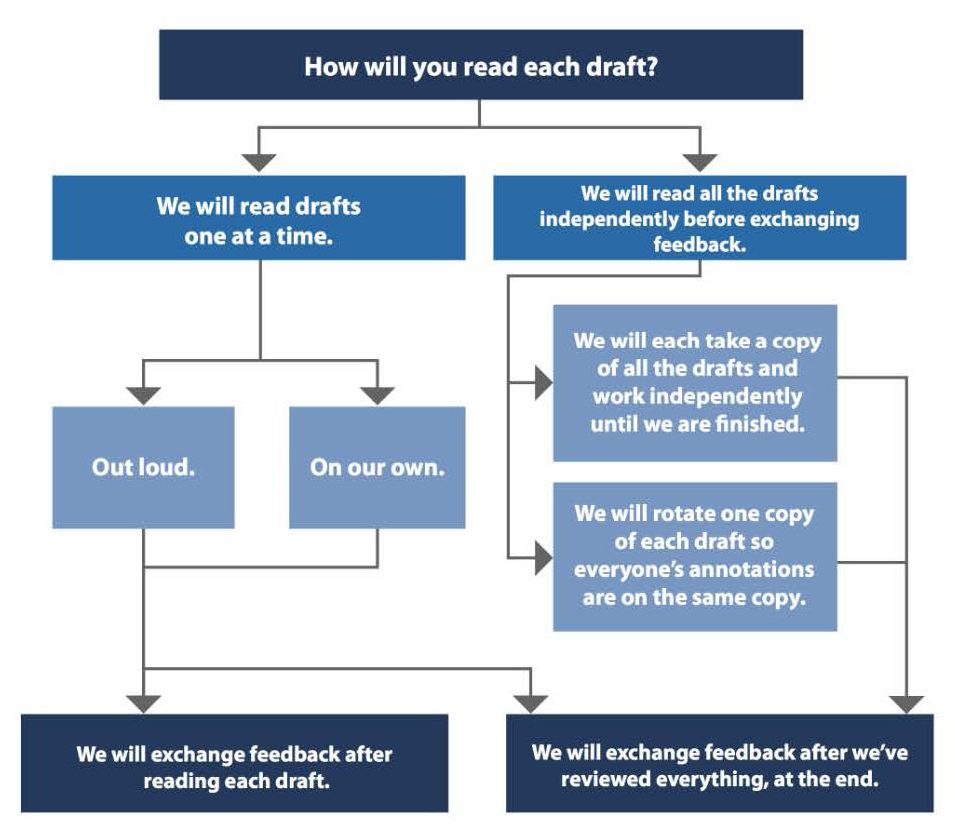
Finally, this flowchart from Abrams’ chapter will help you figure out what the culture and principles of your workshop group will be:
Don’t Worry If Your Peers Are Late!
You aren’t responsible for reading any papers that weren’t posted to #team by Sunday, but if you post your draft late, you’re still responsible for reviewing the other essays by Friday. Missing peer review does count as missed work, and impacts your final course grade, so make sure to complete peer review by the deadline. I note when students post drafts and who actively participates in peer review and who doesn’t.
This week, you’ll asynchronously workshop each other’s drafts in your #team channel. In addition to Straub’s suggestions, here are some structured instructions for conducting peer review.
Process Reflection
When you post your draft to #team, you’ll post a brief process reflection (~200-300 words) along with it. In this reflection post, you’ll explain your process of working on this draft by answering some or all of the following:
- What were your thought processes in developing your ideas and doing your research?
- What do you wish you’d had more time to work on?
- What do you want to do between this draft and the next, regarding both what you want to do personally and what the assignment guidelines ask you to do?
Be Honest!
Don’t just tell me what you think I want to hear! Your task isn’t to try to please me or impress me, but to help me help you refine your process of writing this project as well as refine your intentions for yourself as a developing writer. The more honest you are in your process reflections, the easier your revision decisions will get over time!
You can identify the assignment parameters you think you met and why, referencing the modules and instructions as evidence, and which you think you need to keep striving towards. If you want to, you can also note any regrets or difficulties you faced, any burdens or college or life that crept into your work, your attitude towards the assignment, and so on.
Workshop Instructions
Your workshop will be guided by the Feedback Survey below, which is a set of questions you should answer for each of your teammates’ papers.
Here are the general instructions:
-
Out of respect for your team members, please post your drafts (plus process reflection) to your #team channel by Tuesday so your peers have time to read and review before the end of the week. (If you post a Google Doc link make sure you’ve enabled sharing permissions.)
-
Using the questions and Abrams’ flowchart pictured earlier in this module, chat briefly about how you approach workshops, what good feedback is, and what the culture and workflow of your workshop session is going to be.
-
Don’t talk about your essays! First, read without commenting. You can read and make marginalia, underline/highlight what you think the claim is, make notes about what you think the writer’s aims are, etc.
-
Answer all the questions in the Feedback Survey below for each of your teammates’ drafts, and post your answers as a reply to your teammate in your #team channel. This process must be complete by Fri 11:59PM.
-
After receiving feedback, read what your teammates wrote, and discuss any questions you have together as a group. You may want to ask questions about what their comments mean, how they suggest enacting those comments, collaboratively write your way towards enacting those comments, and so on.
Feedback Survey: Unit 1 Draft 1
🛑 Feedback Survey and General Feedback
The Feedback Survey questions are below and should be used in your #team workshops. I’ll interact with you during the week, much like I do with our usual Q&A posts. The survey is adapted from the General Feedback page, and should be used to help you think through the scores and feedback you received (and help you ask feedback-related questions in #team).
Answer the below questions for each of your teammates’ drafts. Post your responses to your #team channel as a reply to each teammate (or tag them in your post with @username). Keep Staub’s framework in mind as you answer them!
- Do the writer’s research questions/hypotheses and establishment of the disciplinary problem they’re investigating seem to emerge out of deep familiarity with existing scholarship about that problem in their field?
- What words, phrases, and other textual evidence indicate this?
- If not, what do you suggest the writer search for or read up on?
- Are the writer’s research questions/hypotheses:
- An obvious fact or a statement that seems easily guessed at through common sense, or an attempt to solve a problem that can’t be solved in this one project (indicated by “What are the best/most effective ways/strategies to do X”)?
- Inarguable because it relies too heavily on opinion or guesswork that can’t be substantiated or isn’t grounded in the literature?
- What words, phrases, and other textual evidence indicate this?
- Are the writer’s research questions/hypotheses too general and/or too broad, i.e. if you ask “what kind” are you able to answer it with a narrower demographic or subset or direction of the problem under investigation, are you able to provide an answer?
- What words, phrases, and other textual evidence indicate this?
- Are the writer’s research questions/hypotheses too speculative, i.e. is it more focused on things that can’t be easily accomplished through limited research like people’s motivations (indicated by “why do people do X” style questions, or “why does X thing happen” questions)?
- What words, phrases, and other textual evidence indicate this?
Assignment-Related Questions
- When you compare the draft with the Unit 1 guidelines, what major criteria are absent or need improvement? Tell the writer how they might take care of that.
- What 2-3 items from the feedback survey questions above feel like top priority items for the writer’s paper?
- Is there enough background (summarized from the writer’s preliminary research) to explain how the writer’s research hypothesis emerged from the current state of their field? If not, tell the writer what you still need to know to understand that connection.
While I can’t require sync chats with me to go over feedback with you, I highly recommend them if you’re able to manage a 10-20 min coffee chat!
Happy drafting and reviewing!
Exit Writing
🥳 Congratulations on getting through this chapter! Don’t forget to check the Calendar for the week’s assignments, including your process reflection and #team posts as well as any other assigned writing. Make sure to look ahead to future weeks as well to get a sense of when low- and high-stakes writing for the rest of Unit 1 is due.
Reference List for This Week’s Resources
| Shane Abrams (adapted by Liz Delf, Rob Drummond, Kristy Kelly) | “Concepts and Strategies for Revision” |
| Richard Straub | “Responding — Really Responding — to Other Students’ Writing” |